What is the Science of Reading?
What Is the Science of Reading?
Parents researching reading difficulties often encounter the phrase Science of Reading. It appears in educational articles, school improvement plans, teacher training programs, and discussions about dyslexia intervention. But what exactly does it mean?
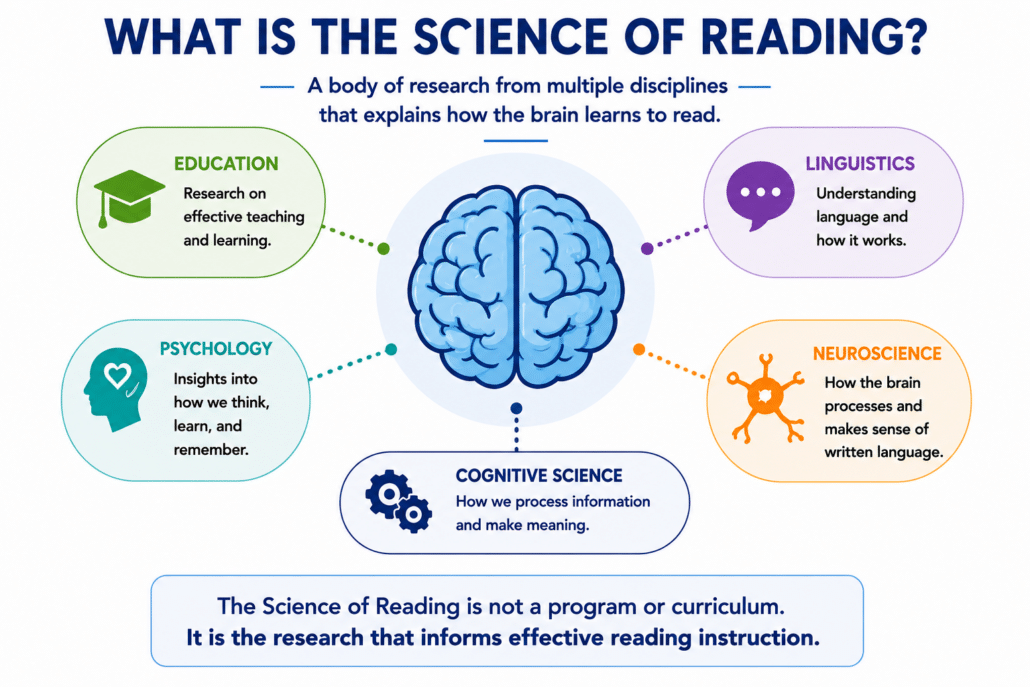
Simply put, the Science of Reading refers to decades of research examining how the brain learns to read and which instructional practices are most effective for helping students become skilled readers.
Rather than being a single program or curriculum, the Science of Reading is a large body of scientific evidence drawn from education, psychology, linguistics, neuroscience, and cognitive science.

Reading Is Not a Natural Process
Unlike spoken language, reading is not something the human brain develops automatically. Children naturally learn to speak through exposure and interaction. Reading is different. To become successful readers, students must learn how spoken sounds connect to written letters and patterns. This process requires explicit instruction and practice.
Research has consistently shown that many students benefit from direct instruction in foundational reading skills rather than being expected to discover these skills independently.
The Five Pillars of Reading
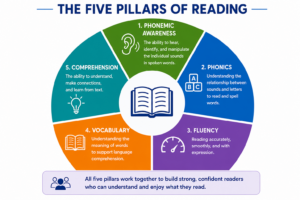
The National Reading Panel identified five essential components of effective reading instruction.
1. Phonemic Awareness
Phonemic awareness is the ability to hear, identify, and manipulate the individual sounds in spoken words.
Examples include:
- Identifying the first sound in cat
- Blending sounds together to form words
- Breaking words into individual sounds
This skill forms the foundation for learning to decode words.
2. Phonics
Phonics teaches the relationship between sounds and letters.
Students learn:
- Letter-sound relationships
- Decoding strategies
- Spelling patterns
- Word recognition skills
Strong phonics instruction helps students read unfamiliar words independently.
3. Reading Fluency
Fluent readers read accurately, smoothly, and with appropriate expression. When students become more fluent, they can devote more mental energy to understanding what they read rather than focusing solely on decoding individual words.
4. Vocabulary
Students must understand the meaning of words in order to understand text.
Vocabulary grows through:
- Reading
- Conversation
- Direct instruction
- Exposure to rich language
A strong vocabulary supports both reading comprehension and written expression.
5. Reading Comprehension
The ultimate goal of reading is understanding.
Comprehension involves:
- Understanding ideas
- Making connections
- Drawing conclusions
- Learning from text
All of the other reading skills work together to support comprehension.

What About Dyslexia?
One reason the Science of Reading has gained attention is its strong connection to dyslexia intervention.
Research shows that many students with dyslexia benefit from:
- Explicit instruction
- Structured literacy
- Systematic phonics instruction
- Frequent review and practice
These principles align closely with what research has identified as effective reading instruction.
The Science of Reading Is Not a Program
This is one of the biggest misconceptions. The Science of Reading is not a specific curriculum, commercial program, or single instructional method. Instead, it is the research that helps educators determine which instructional approaches are most effective.
Many programs incorporate principles from the Science of Reading, but no single program owns the research.
How Colorado Reading Center Uses the Science of Reading
At Colorado Reading Center, our instructional approach incorporates many principles supported by the Science of Reading.
Instruction is:
- Explicit
- Systematic
- Individualized
- Assessment-driven
- Focused on measurable progress
We combine evidence-based practices with ongoing assessment and progress monitoring to ensure instruction addresses each student’s unique needs. Rather than following a single program for every learner, we use research-supported instructional strategies to build individualized plans designed around the student.
The Goal Is Reading Success
The Science of Reading is not about choosing sides in educational debates. It is not about advocating or selling a specific instructional program or curriculum. It is about understanding how students learn to read and using that knowledge to provide effective instruction. When instruction is guided by research, tailored to the learner, and delivered consistently, students can develop the skills, confidence, and independence needed for lifelong reading success.
At Colorado Reading Center, our instructional approach incorporates many principles supported by the Science of Reading. Students receive one-on-one instruction, ongoing progress monitoring, written session notes, and individualized lesson planning designed around their specific needs and goals.
Is the Science of Reading a Program?
No. The Science of Reading is not a specific curriculum, textbook, or commercial program. Instead, it is a large body of research that examines how students learn to read and which instructional practices are most effective. Programs such as Orton-Gillingham, Barton, Wilson, and Really Great Reading may incorporate principles supported by the Science of Reading, but no single program owns the research. At Colorado Reading Center, we use evidence-based instructional practices informed by reading research while individualizing instruction to meet each student’s needs.
Is Orton-Gillingham Part of the Science of Reading?
Orton-Gillingham is not the Science of Reading itself, but many of its instructional principles align closely with research-supported reading practices. Orton-Gillingham emphasizes explicit instruction, systematic phonics, multisensory learning, and cumulative review. These elements are consistent with many findings within the Science of Reading. At Colorado Reading Center, we incorporate many structured literacy practices found in Orton-Gillingham while maintaining the flexibility to draw from additional evidence-based approaches when appropriate.
Do You Use Barton Reading & Spelling?
Colorado Reading Center is not limited to a single reading program. However, we utilize many instructional principles that parents may recognize from programs such as Barton Reading & Spelling, including explicit instruction, systematic skill development, cumulative review, and diagnostic teaching. Our goal is to provide individualized instruction based on assessment data and student needs rather than following a predetermined sequence for every learner.
Do You Use Seeing Stars or Visualizing and Verbalizing?
Many students benefit from imagery-based instruction to support reading, spelling, fluency, and comprehension. Colorado Reading Center incorporates strategies inspired by programs such as Seeing Stars and Visualizing and Verbalizing when they align with a student’s instructional needs. Our focus is always on selecting the techniques that best support learning rather than requiring every student to follow the same program.
What Reading Programs Do You Use?
Colorado Reading Center draws from a variety of research-based instructional approaches. The Phonological Analysis with Synthetic Phonics (PASP) Program uses a multi-sensory approach to teach students how to hear, feel, and name sounds in words. Through structured phonics lessons, designed to develop phonological processing, students learn to connect sounds with letters. This flexibility allows us to develop individualized instructional plans based on assessment results, student needs, and ongoing progress monitoring.