


The Neurological Impress Method (NIM): A Simple Reading Strategy Parents Can Use at Home
Many parents of struggling readers ask the same question:
“How can I help my child become a more fluent reader at home?”
While there is no single activity that solves every reading difficulty, one technique has been helping struggling readers for decades. It is called the Neurological Impress Method (NIM). Despite the complicated name, the process is surprisingly simple and can be completed in just 10 to 15 minutes per day.

What Is the Neurological Impress Method?
The Neurological Impress Method was developed as a way to help struggling readers experience successful reading while receiving support from a more fluent reader. During the activity, the parent and child read the same text aloud together. The parent reads slightly louder and slightly ahead of the child while pointing to the words. The child follows along and attempts to match the parent’s pace, pronunciation, and expression. The goal is not perfection. The goal is to provide the child with a model of fluent reading while they actively participate in the reading process. Think of it as riding a bicycle with training wheels. The child is still doing the work, but the support allows them to experience success while developing confidence and fluency.
Why Does It Work?
Reading fluency requires several skills to work together:
- Accurate word recognition
- Automatic decoding
- Appropriate reading rate
- Expression and phrasing
- Reading stamina
Many struggling readers spend so much energy figuring out individual words that they have little mental energy left for comprehension. The Neurological Impress Method provides immediate support while exposing the student to fluent reading patterns. Over time, many students begin to read more smoothly, recognize words more quickly, and develop greater confidence. Research has shown positive outcomes for many students who struggle with reading fluency, including students with dyslexia and other reading difficulties.*
How to Use the Neurological Impress Method at Home
Step 1: Choose the Right Book
Select a book that:
- Interests your child
- Is not overly difficult
- Contains enough text for continuous reading
- Can be completed in small sections
High-interest chapter books, nonfiction books, and graphic novels can all work well.
Step 2: Sit Side-by-Side
Sit next to your child rather than across from them. Both readers should be able to see the text easily.
Step 3: Read Together
Begin reading aloud at the same time.
As the parent:
- Read slightly louder
- Read slightly ahead
- Maintain a comfortable pace
- Use natural expression
Avoid stopping frequently to correct errors. The purpose is to keep the reading moving.
Step 4: Point to the Words
Use your finger to track the text as you read. This helps maintain attention and supports accurate visual tracking.
Step 5: Keep Sessions Short
Ten to fifteen minutes is usually enough. Consistency matters more than duration. A short session completed four or five times per week is often more beneficial than a single long session.

Common Mistakes to Avoid
Turning It Into a Test
Avoid constantly correcting mistakes. The activity should feel supportive, not stressful.
Choosing Text That Is Too Difficult
If your child becomes frustrated or stops participating, the text may be too challenging.
Reading Too Fast
The goal is supported success, not speed. Maintain a pace that allows your child to participate comfortably.
Who Benefits Most?
The Neurological Impress Method is often helpful for students who:
- Read slowly and laboriously
- Struggle with reading fluency
- Have difficulty building reading confidence
- Need additional practice between tutoring sessions
- Have dyslexia or other reading-based learning difficulties
Final Thoughts
Parents often feel pressure to become reading teachers at home. Fortunately, helping your child become a stronger reader does not always require complicated programs or specialized training. The Neurological Impress Method provides a simple way to support reading fluency, confidence, and engagement in just a few minutes each day. When combined with explicit reading instruction and consistent practice, this technique can become a valuable part of a child’s reading growth journey.
* Hudson, A. K., Pullen, P. C., Lane, H. B., & Torgesen, J. K. (2020). Fluency Interventions for Elementary Students with Reading Difficulties: A Systematic Review. Education Sciences, 10(3), 52.

What is the Science of Reading?
What Is the Science of Reading?
Parents researching reading difficulties often encounter the phrase Science of Reading. It appears in educational articles, school improvement plans, teacher training programs, and discussions about dyslexia intervention. But what exactly does it mean?
Simply put, the Science of Reading refers to decades of research examining how the brain learns to read and which instructional practices are most effective for helping students become skilled readers.
Rather than being a single program or curriculum, the Science of Reading is a large body of scientific evidence drawn from education, psychology, linguistics, neuroscience, and cognitive science.

Reading Is Not a Natural Process
Unlike spoken language, reading is not something the human brain develops automatically. Children naturally learn to speak through exposure and interaction. Reading is different. To become successful readers, students must learn how spoken sounds connect to written letters and patterns. This process requires explicit instruction and practice.
Research has consistently shown that many students benefit from direct instruction in foundational reading skills rather than being expected to discover these skills independently.
The Five Pillars of Reading
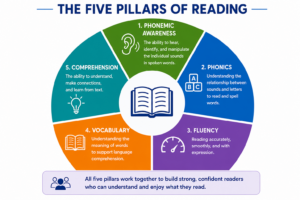
The National Reading Panel identified five essential components of effective reading instruction.
1. Phonemic Awareness
Phonemic awareness is the ability to hear, identify, and manipulate the individual sounds in spoken words.
Examples include:
- Identifying the first sound in cat
- Blending sounds together to form words
- Breaking words into individual sounds
This skill forms the foundation for learning to decode words.
2. Phonics
Phonics teaches the relationship between sounds and letters.
Students learn:
- Letter-sound relationships
- Decoding strategies
- Spelling patterns
- Word recognition skills
Strong phonics instruction helps students read unfamiliar words independently.
3. Reading Fluency
Fluent readers read accurately, smoothly, and with appropriate expression. When students become more fluent, they can devote more mental energy to understanding what they read rather than focusing solely on decoding individual words.
4. Vocabulary
Students must understand the meaning of words in order to understand text.
Vocabulary grows through:
- Reading
- Conversation
- Direct instruction
- Exposure to rich language
A strong vocabulary supports both reading comprehension and written expression.
5. Reading Comprehension
The ultimate goal of reading is understanding.
Comprehension involves:
- Understanding ideas
- Making connections
- Drawing conclusions
- Learning from text
All of the other reading skills work together to support comprehension.

What About Dyslexia?
One reason the Science of Reading has gained attention is its strong connection to dyslexia intervention.
Research shows that many students with dyslexia benefit from:
- Explicit instruction
- Structured literacy
- Systematic phonics instruction
- Frequent review and practice
These principles align closely with what research has identified as effective reading instruction.
The Science of Reading Is Not a Program
This is one of the biggest misconceptions. The Science of Reading is not a specific curriculum, commercial program, or single instructional method. Instead, it is the research that helps educators determine which instructional approaches are most effective.
Many programs incorporate principles from the Science of Reading, but no single program owns the research.
How Colorado Reading Center Uses the Science of Reading
At Colorado Reading Center, our instructional approach incorporates many principles supported by the Science of Reading.
Instruction is:
- Explicit
- Systematic
- Individualized
- Assessment-driven
- Focused on measurable progress
We combine evidence-based practices with ongoing assessment and progress monitoring to ensure instruction addresses each student’s unique needs. Rather than following a single program for every learner, we use research-supported instructional strategies to build individualized plans designed around the student.
The Goal Is Reading Success
The Science of Reading is not about choosing sides in educational debates. It is not about advocating or selling a specific instructional program or curriculum. It is about understanding how students learn to read and using that knowledge to provide effective instruction. When instruction is guided by research, tailored to the learner, and delivered consistently, students can develop the skills, confidence, and independence needed for lifelong reading success.
At Colorado Reading Center, our instructional approach incorporates many principles supported by the Science of Reading. Students receive one-on-one instruction, ongoing progress monitoring, written session notes, and individualized lesson planning designed around their specific needs and goals.
Is the Science of Reading a Program?
No. The Science of Reading is not a specific curriculum, textbook, or commercial program. Instead, it is a large body of research that examines how students learn to read and which instructional practices are most effective. Programs such as Orton-Gillingham, Barton, Wilson, and Really Great Reading may incorporate principles supported by the Science of Reading, but no single program owns the research. At Colorado Reading Center, we use evidence-based instructional practices informed by reading research while individualizing instruction to meet each student’s needs.
Is Orton-Gillingham Part of the Science of Reading?
Orton-Gillingham is not the Science of Reading itself, but many of its instructional principles align closely with research-supported reading practices. Orton-Gillingham emphasizes explicit instruction, systematic phonics, multisensory learning, and cumulative review. These elements are consistent with many findings within the Science of Reading. At Colorado Reading Center, we incorporate many structured literacy practices found in Orton-Gillingham while maintaining the flexibility to draw from additional evidence-based approaches when appropriate.
Do You Use Barton Reading & Spelling?
Colorado Reading Center is not limited to a single reading program. However, we utilize many instructional principles that parents may recognize from programs such as Barton Reading & Spelling, including explicit instruction, systematic skill development, cumulative review, and diagnostic teaching. Our goal is to provide individualized instruction based on assessment data and student needs rather than following a predetermined sequence for every learner.
Do You Use Seeing Stars or Visualizing and Verbalizing?
Many students benefit from imagery-based instruction to support reading, spelling, fluency, and comprehension. Colorado Reading Center incorporates strategies inspired by programs such as Seeing Stars and Visualizing and Verbalizing when they align with a student’s instructional needs. Our focus is always on selecting the techniques that best support learning rather than requiring every student to follow the same program.
What Reading Programs Do You Use?
Colorado Reading Center draws from a variety of research-based instructional approaches. The Phonological Analysis with Synthetic Phonics (PASP) Program uses a multi-sensory approach to teach students how to hear, feel, and name sounds in words. Through structured phonics lessons, designed to develop phonological processing, students learn to connect sounds with letters. This flexibility allows us to develop individualized instructional plans based on assessment results, student needs, and ongoing progress monitoring.

What is the best reading intervention program?
Why We Don’t Follow Just One Reading Program
Parents often ask whether Colorado Reading Center uses Orton-Gillingham, Barton Reading & Spelling, Wilson Reading System, Seeing Stars, Really Great Reading, or other well-known literacy programs. The answer is both simple and important:
We draw from many research-based programs and approaches rather than limiting instruction to a single program.
What Do These Programs Have in Common?
Programs such as Orton-Gillingham, Barton, Wilson, Really Great Reading, and Seeing Stars share many important characteristics. They emphasize explicit instruction, systematic skill development, structured practice, and ongoing review. Many are grounded in principles supported by the science of reading and have helped countless students develop stronger literacy skills. At Colorado Reading Center, we value many of the instructional practices found within these programs.
The Challenge With Following Only One Program
Every student is different. Some students struggle primarily with decoding. Others have difficulty with spelling, reading fluency, comprehension, vocabulary, visual imagery, language processing, or written expression. While a single program may be highly effective for one student, it may not address every area of need for another.
A program is a tool. Effective instruction requires selecting the right tools for the individual student.
A Flexible, Individualized Approach
Rather than following a single scripted sequence for every student, Colorado Reading Center develops instruction based on assessment data, student performance, and ongoing progress monitoring.

Our clinicians incorporate instructional techniques and activities inspired by these well know programs. This flexibility allows us to target the specific skills each student needs while adapting instruction as progress occurs.
Why Flexibility Matters
Imagine two students who both struggle with reading. One student may need intensive work in phonemic awareness and decoding. Another student may decode accurately but struggle to create mental imagery, understand text, and answer comprehension questions. Although both students have reading difficulties, they require very different instructional plans. A one-size-fits-all program may not fully address both students’ needs.
By combining proven instructional methods, we can build a plan that matches the learner rather than forcing the learner to fit the program.
Progress Drives Instruction
At Colorado Reading Center, instructional decisions are guided by ongoing assessment and progress monitoring. As students develop new skills, instruction evolves to match their changing needs. This allows us to provide targeted support while maintaining a clear focus on measurable growth.

Our goal is not to deliver a particular program. Our goal is to help students become stronger, more confident readers.
The Best Program Is the One That Meets the Student’s Needs
Orton-Gillingham, Barton, Wilson, Seeing Stars, Really Great Reading, and other structured literacy programs have contributed valuable ideas to the field of reading instruction.
Rather than asking which program is best, we believe a better question is: “What does this student need right now?”
By drawing from multiple evidence-based approaches, Colorado Reading Center is able to provide individualized instruction designed around the student rather than around a single curriculum. Because ultimately, students learn best when instruction is built to fit their needs.

News


