
Find resources to use while reading with your children at home.


The Neurological Impress Method (NIM): A Simple Reading Strategy Parents Can Use at Home
Many parents of struggling readers ask the same question:
“How can I help my child become a more fluent reader at home?”
While there is no single activity that solves every reading difficulty, one technique has been helping struggling readers for decades. It is called the Neurological Impress Method (NIM). Despite the complicated name, the process is surprisingly simple and can be completed in just 10 to 15 minutes per day.

What Is the Neurological Impress Method?
The Neurological Impress Method was developed as a way to help struggling readers experience successful reading while receiving support from a more fluent reader. During the activity, the parent and child read the same text aloud together. The parent reads slightly louder and slightly ahead of the child while pointing to the words. The child follows along and attempts to match the parent’s pace, pronunciation, and expression. The goal is not perfection. The goal is to provide the child with a model of fluent reading while they actively participate in the reading process. Think of it as riding a bicycle with training wheels. The child is still doing the work, but the support allows them to experience success while developing confidence and fluency.
Why Does It Work?
Reading fluency requires several skills to work together:
- Accurate word recognition
- Automatic decoding
- Appropriate reading rate
- Expression and phrasing
- Reading stamina
Many struggling readers spend so much energy figuring out individual words that they have little mental energy left for comprehension. The Neurological Impress Method provides immediate support while exposing the student to fluent reading patterns. Over time, many students begin to read more smoothly, recognize words more quickly, and develop greater confidence. Research has shown positive outcomes for many students who struggle with reading fluency, including students with dyslexia and other reading difficulties.*
How to Use the Neurological Impress Method at Home
Step 1: Choose the Right Book
Select a book that:
- Interests your child
- Is not overly difficult
- Contains enough text for continuous reading
- Can be completed in small sections
High-interest chapter books, nonfiction books, and graphic novels can all work well.
Step 2: Sit Side-by-Side
Sit next to your child rather than across from them. Both readers should be able to see the text easily.
Step 3: Read Together
Begin reading aloud at the same time.
As the parent:
- Read slightly louder
- Read slightly ahead
- Maintain a comfortable pace
- Use natural expression
Avoid stopping frequently to correct errors. The purpose is to keep the reading moving.
Step 4: Point to the Words
Use your finger to track the text as you read. This helps maintain attention and supports accurate visual tracking.
Step 5: Keep Sessions Short
Ten to fifteen minutes is usually enough. Consistency matters more than duration. A short session completed four or five times per week is often more beneficial than a single long session.

Common Mistakes to Avoid
Turning It Into a Test
Avoid constantly correcting mistakes. The activity should feel supportive, not stressful.
Choosing Text That Is Too Difficult
If your child becomes frustrated or stops participating, the text may be too challenging.
Reading Too Fast
The goal is supported success, not speed. Maintain a pace that allows your child to participate comfortably.
Who Benefits Most?
The Neurological Impress Method is often helpful for students who:
- Read slowly and laboriously
- Struggle with reading fluency
- Have difficulty building reading confidence
- Need additional practice between tutoring sessions
- Have dyslexia or other reading-based learning difficulties
Final Thoughts
Parents often feel pressure to become reading teachers at home. Fortunately, helping your child become a stronger reader does not always require complicated programs or specialized training. The Neurological Impress Method provides a simple way to support reading fluency, confidence, and engagement in just a few minutes each day. When combined with explicit reading instruction and consistent practice, this technique can become a valuable part of a child’s reading growth journey.
* Hudson, A. K., Pullen, P. C., Lane, H. B., & Torgesen, J. K. (2020). Fluency Interventions for Elementary Students with Reading Difficulties: A Systematic Review. Education Sciences, 10(3), 52.

What Parents Should Know About 504 Plans and IEPs
As a parent, you know your child best. If your child is struggling more than expected in school, you might be wondering what support is available. In Colorado, families have the right to ask their school district for a formal evaluation to see if their child qualifies for special education services through an Individualized Education Program (IEP) or accommodations under a 504 Plan.
The process often begins with a written request to your child’s school or the district’s Child Find office. From there, the school will gather information, conduct assessments (with your consent), and meet with you to discuss whether your child qualifies for extra supports.
Knowing where to start can feel overwhelming, but the good news is that Colorado offers clear procedures, resources, and parent supports to guide you every step of the way. Below are some key differences between each service and some help on how to get started.

Section 504 Plan
- Based on Section 504 of the Rehabilitation Act of 1973, a civil rights law that prohibits discrimination on the basis of disability.
- Ensures that a student with a disability has equal access to education and school programs by providing accommodations and supports.
- Accommodations might include preferential seating, extended time on tests, breaks, use of assistive technology, modified assignments, etc.
- You can learn more about Section 504 here: https://www.ed.gov/laws-and-policy/individuals-disabilities/section-504
Individualized Education Program (IEP)
- Governed under the Individuals with Disabilities Education Act (IDEA).
- An IEP is a legally binding document that spells out special education services, supports, and modifications your child needs to make progress in school.
- It describes your child’s current performance, measurable goals, how those goals will be assessed, and when/where services will be delivered.
- You can learn more about the IDEA here: https://www.ed.gov/laws-and-policy/individuals-disabilities/idea
Key Differences
| Feature | 504 Plan | IEP |
| Legal basis | Rehabilitation Act (civil rights) | IDEA (special education law) |
| Who qualifies | Broad definition of disability; substantial limitation in one or more life activity (e.g., learning) | Must meet IDEA’s criteria (one of the categories) and need special education to benefit from school |
| Type of support | Accommodations and supports in general education | Specialized instruction, related services, accommodations/modifications |
| Academic goals or benchmarks | Typically no (or less detailed) goals | Yes — annual goals, progress measurement |
| Team and process | Usually a 504 team (teacher, admin, parent) | Formal IEP team (parents, teachers, specialists, administrator) |
| Frequency of review | Varies (often annually) | At least annually; full reevaluation every 3 years (or more frequently if needed) |
| Scope of protections | Includes access to extracurriculars, nonacademic settings, discrimination protections | Also includes protections but more focused on instruction and educational progress |

What to Expect and What Parents Should Do
Getting Started / Eligibility
- You or your child’s teacher can request an evaluation if you suspect the child has a disability or learning difficulty by contacting the school district’s Child Find or Special Education Department. (For IEP, it’s a full identification under IDEA.) https://www.cde.state.co.us/cdesped/referralresourcefamilies
- Some districts have an intake / referral form that parents can fill out (e.g. DPS’s Child Find has an “intake form” online). https://ess.dpsk12.org/page/child-find
Development
- For an IEP, the IEP team meets to write the plan, including goals, services, accommodations, and how progress will be reported.
- For a 504 plan, the team decides what accommodations and supports are needed to give your child equal access.
Implementation and Monitoring
- Parents should stay involved: ask for progress reports, observe how supports are working, and request changes if needed.
- Both plans should be reviewed periodically. For IEPs, there is at least an annual review and triennial reevaluation.
- If you disagree with decisions, you have the right to due process, mediation, or an impartial hearing (for both 504 and IEP).
Why They Matter
- Promote access and equity. These plans help reduce barriers so children with disabilities can engage meaningfully in school and reach their potential.
- Reduce unnecessary frustration. With appropriate supports, a child may be better able to demonstrate their true strengths and keep pace with peers.
- Legal protection. These are not merely helpful — they are rights guaranteed by law.
Navigating the world of resources and services can be daunting. Feel free to reach out the the Colorado Reading Center if you have any questions about this process or would like to start with an academic assessment to get an accurate measure of you child’s reading skills.

The Importance of Vocabulary for Reading Comprehension
When it comes to reading comprehension, vocabulary knowledge is essential. Without a strong vocabulary, readers may struggle to make sense of the texts they encounter. But why is vocabulary so important, and how can parents and educators help build it effectively?
Vocabulary: The Key to Unlocking Meaning

Research shows that a rich vocabulary enhances both basic understanding and deeper comprehension. Readers use vocabulary to grasp the literal meaning of a text and to infer hidden messages. Both types of understanding depend on a reader’s knowledge of words.
Vocabulary, Mental Imagery, and Cognitive Development

Mental imagery strengthens the connection between vocabulary and comprehension. Descriptive words help readers create pictures in their minds, making the text more engaging and easier to remember. For instance, phrases like “lush forest” or “towering skyscraper” trigger vivid mental images, enhancing understanding and creating a richer reading experience.
Building Vocabulary: Strategies for Success
Here are some practical strategies to support vocabulary development:
- Read Aloud Together: Reading aloud introduces children to new words in context. Choose books slightly above their independent reading level to help expand their vocabulary.
- Encourage Wide Reading: Provide access to a variety of materials, including fiction, nonfiction, poetry, and informational texts. Different genres introduce unique words and ideas.
- Teach Word-Learning Strategies: Show students how to figure out unfamiliar words by teaching prefixes, suffixes, root words, and context clues.
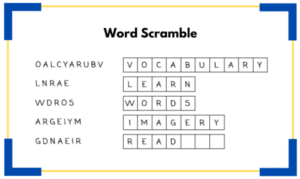
- Play Word Games: Games like Scrabble, Boggle, or vocabulary apps make learning fun and interactive.
- Talk About Words: Discuss interesting or unusual words during conversations at home or in the classroom. This builds curiosity about language.
- Use Visual Imagery: Use visual imagery to create vivid mental images of vocabulary words. This taps into personal experience as well as visualization for better memory.
- Reinforce Through Writing: Encourage students to use new vocabulary in their writing. This strengthens understanding and helps solidify word meanings in memory.

Long-Term Benefits of a Strong Vocabulary
A strong vocabulary doesn’t just support reading comprehension—it’s a lifelong skill. From academic success to career readiness, vocabulary enables individuals to express themselves clearly, understand complex ideas, and engage with the world. It also enhances critical thinking and problem-solving abilities, which makes it a vital part of overall learning.

Final Thoughts
Building a strong vocabulary is an investment in a child’s success. By creating word-rich environments at home and in the classroom, parents and educators can empower young readers to thrive. Incorporating mental imagery techniques can make reading more vivid and memorable and turn every book into an adventure. The more words a child knows, the more opportunities they have—in books and in life.
If you or your child needs help with Reading Comprehension, we can help! Reach out to learn about our ReadingFish program for reading comprehension today!

Practice with a Word Box
As emerging readers develop, they begin to add significantly to their word base. Reading consists of several skills, one of which is the memorization of many high frequency words, or sight words. These are words that occur often when we read and tend to make up the majority of the words we read when reading. There are many high frequency or sight word lists that parents and teachers can choose from. For our purposes, we us the Fry’s Instant Word List.
According to E. B. Fry, who developed the Fry’s Instant Word List, there are 300 words that are essential to developing readers. It is suggested that: “This list contains the most commonly used words in written English, ranked in frequency order. The 300 instant words and their common variants make up 65% of all the words in any textbook, any newspaper, or any writing sample in English.” (Rite Flight: A Classroom Reading Program: 2006, 169) Therefore, the faster a student is able to recognize these words, the less effort they will need to decode these words and the quicker their reading rate will be.

The Word Box is a tool designed to give students repetitive practice with orthographically inconsistent words, or high frequency sight words. It is a simple tool that, when used consistently and properly, is very powerful. Words are added that the student doesn’t know from either a high frequency word list or from words missed in their reading.
Every student will have a box, which will hold all their unknown sight words. There are several categories of sight words: slow, medium, fast, and graduates. We encourage students to pick their own labels for these categories in order to personalize their box (ex. snails, dogs, eagles, etc).
When a new word is added, it will begin in the slow category. Once the student is able to correctly read the word, it will move up to the medium category.
When the student is able to read the word within two seconds, it will move up to the fast category.
Once a word is in the fast category, the student must read it correctly 5 times in a row to move it up to “graduate.” This must be read within a second. Remember these should be instant words, and students should recognize them as quickly as they recognize their own name. We will mark each correct reading of a fast word with a check on the back of the index card to keep track. Occasionally a word may be misread, or slow, in which case it will need to move down a category.
The word is printed neatly in black marker on the blank side of an index card and added to the box. Every so often a student may need a visual “hint” to help them recognize a word. This is done lightly in pencil and is erased when the word has moved up to the fast category.
When students miss words, it is helpful to have them image or visualize the word by drawing it on the table or in the air with their finger. This will help develop their visual memory for the word so it can be easily recognized in the future.
Students should practice their box several times a week for 10-15 minutes. The word box is an effective and strategic way for students to develop their word knowledge.

News


