Posts

What is the Science of Reading?

What Is the Science of Reading?

Parents researching reading difficulties often encounter the phrase Science of Reading. It appears in educational articles, school improvement plans, teacher training programs, and discussions about dyslexia intervention. But what exactly does it mean?

Simply put, the Science of Reading refers to decades of research examining how the brain learns to read and which instructional practices are most effective for helping students become skilled readers.

Rather than being a single program or curriculum, the Science of Reading is a large body of scientific evidence drawn from education, psychology, linguistics, neuroscience, and cognitive science.

Reading Is Not a Natural Process

Unlike spoken language, reading is not something the human brain develops automatically. Children naturally learn to speak through exposure and interaction. Reading is different. To become successful readers, students must learn how spoken sounds connect to written letters and patterns. This process requires explicit instruction and practice.

Research has consistently shown that many students benefit from direct instruction in foundational reading skills rather than being expected to discover these skills independently.
The Five Pillars of Reading

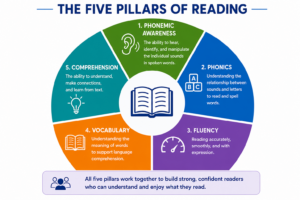
The National Reading Panel identified five essential components of effective reading instruction.

1. Phonemic Awareness

Phonemic awareness is the ability to hear, identify, and manipulate the individual sounds in spoken words.

Examples include:

  • Identifying the first sound in cat
  • Blending sounds together to form words
  • Breaking words into individual sounds

This skill forms the foundation for learning to decode words.

2. Phonics

Phonics teaches the relationship between sounds and letters.

Students learn:

  • Letter-sound relationships
  • Decoding strategies
  • Spelling patterns
  • Word recognition skills

Strong phonics instruction helps students read unfamiliar words independently.

3. Reading Fluency

Fluent readers read accurately, smoothly, and with appropriate expression. When students become more fluent, they can devote more mental energy to understanding what they read rather than focusing solely on decoding individual words.

4. Vocabulary

Students must understand the meaning of words in order to understand text.

Vocabulary grows through:

  • Reading
  • Conversation
  • Direct instruction
  • Exposure to rich language

A strong vocabulary supports both reading comprehension and written expression.

5. Reading Comprehension

The ultimate goal of reading is understanding.

Comprehension involves:

  • Understanding ideas
  • Making connections
  • Drawing conclusions
  • Learning from text

All of the other reading skills work together to support comprehension.

What About Dyslexia?

One reason the Science of Reading has gained attention is its strong connection to dyslexia intervention.

Research shows that many students with dyslexia benefit from:

  • Explicit instruction
  • Structured literacy
  • Systematic phonics instruction
  • Frequent review and practice

These principles align closely with what research has identified as effective reading instruction.

The Science of Reading Is Not a Program

This is one of the biggest misconceptions. The Science of Reading is not a specific curriculum, commercial program, or single instructional method. Instead, it is the research that helps educators determine which instructional approaches are most effective.

Many programs incorporate principles from the Science of Reading, but no single program owns the research.

How Colorado Reading Center Uses the Science of Reading

At Colorado Reading Center, our instructional approach incorporates many principles supported by the Science of Reading.

Instruction is:

  • Explicit
  • Systematic
  • Individualized
  • Assessment-driven
  • Focused on measurable progress

We combine evidence-based practices with ongoing assessment and progress monitoring to ensure instruction addresses each student’s unique needs. Rather than following a single program for every learner, we use research-supported instructional strategies to build individualized plans designed around the student.

The Goal Is Reading Success

The Science of Reading is not about choosing sides in educational debates. It is not about advocating or selling a specific instructional program or curriculum. It is about understanding how students learn to read and using that knowledge to provide effective instruction. When instruction is guided by research, tailored to the learner, and delivered consistently, students can develop the skills, confidence, and independence needed for lifelong reading success.

At Colorado Reading Center, our instructional approach incorporates many principles supported by the Science of Reading. Students receive one-on-one instruction, ongoing progress monitoring, written session notes, and individualized lesson planning designed around their specific needs and goals.

No. The Science of Reading is not a specific curriculum, textbook, or commercial program. Instead, it is a large body of research that examines how students learn to read and which instructional practices are most effective. Programs such as Orton-Gillingham, Barton, Wilson, and Really Great Reading may incorporate principles supported by the Science of Reading, but no single program owns the research. At Colorado Reading Center, we use evidence-based instructional practices informed by reading research while individualizing instruction to meet each student’s needs.

Orton-Gillingham is not the Science of Reading itself, but many of its instructional principles align closely with research-supported reading practices. Orton-Gillingham emphasizes explicit instruction, systematic phonics, multisensory learning, and cumulative review. These elements are consistent with many findings within the Science of Reading. At Colorado Reading Center, we incorporate many structured literacy practices found in Orton-Gillingham while maintaining the flexibility to draw from additional evidence-based approaches when appropriate.

Colorado Reading Center is not limited to a single reading program. However, we utilize many instructional principles that parents may recognize from programs such as Barton Reading & Spelling, including explicit instruction, systematic skill development, cumulative review, and diagnostic teaching. Our goal is to provide individualized instruction based on assessment data and student needs rather than following a predetermined sequence for every learner.

Many students benefit from imagery-based instruction to support reading, spelling, fluency, and comprehension. Colorado Reading Center incorporates strategies inspired by programs such as Seeing Stars and Visualizing and Verbalizing when they align with a student’s instructional needs. Our focus is always on selecting the techniques that best support learning rather than requiring every student to follow the same program.

Colorado Reading Center draws from a variety of research-based instructional approaches. The Phonological Analysis with Synthetic Phonics (PASP) Program uses a multi-sensory approach to teach students how to hear, feel, and name sounds in words. Through structured phonics lessons, designed to develop phonological processing, students learn to connect sounds with letters. This flexibility allows us to develop individualized instructional plans based on assessment results, student needs, and ongoing progress monitoring.

Colorado READ Act (Reading to Ensure Academic Development)

READ Act Basics:

Colorado’s READ Act (Reading to Ensure Academic Development) is aimed at ensuring students with significant reading deficiencies are identified and supported. Under this legislation, struggling students should be identified and receive the support they need to become proficient readers by the end of third grade. The law requires schools to identify students with significant reading deficiencies and create READ plans for intervention. 

Colorado Senate Bill 25-200 expanded the READ Act:

This bill expands the state’s READ Act to include mandatory dyslexia screening for all public-school students in kindergarten through third grade. Starting the 2027–2028 school year, schools must screen for key reading skills like phonological awareness and decoding. Parents will be notified if concerns arise, including signs of dyslexia, and schools must offer a targeted intervention plan. Teachers can now openly discuss dyslexia in meetings and reports. While there are no legal penalties for non-compliance, schools risk losing READ Act funding if they don’t meet these new requirements.

Understanding your child’s rights and the school’s responsibilities under this law can help you advocate more effectively for your child. Colorado Reading Center is here to help you navigate that process. While the READ Act has improved awareness, intervention and district implementation of support varies. Also, there are few repercussions for failing to identify or support struggling students. Supplementing with private support may be necessary if school services are limited.


What Parents Should Know About 504 Plans and IEPs

As a parent, you know your child best. If your child is struggling more than expected in school, you might be wondering what support is available. In Colorado, families have the right to ask their school district for a formal evaluation to see if their child qualifies for special education services through an Individualized Education Program (IEP) or accommodations under a 504 Plan.

The process often begins with a written request to your child’s school or the district’s Child Find office. From there, the school will gather information, conduct assessments (with your consent), and meet with you to discuss whether your child qualifies for extra supports.

Knowing where to start can feel overwhelming, but the good news is that Colorado offers clear procedures, resources, and parent supports to guide you every step of the way. Below are some key differences between each service and some help on how to get started.

Section 504 Plan

  • Based on Section 504 of the Rehabilitation Act of 1973, a civil rights law that prohibits discrimination on the basis of disability.
  • Ensures that a student with a disability has equal access to education and school programs by providing accommodations and supports.
  • Accommodations might include preferential seating, extended time on tests, breaks, use of assistive technology, modified assignments, etc.
  • You can learn more about Section 504 here: https://www.ed.gov/laws-and-policy/individuals-disabilities/section-504

Individualized Education Program (IEP)

  • Governed under the Individuals with Disabilities Education Act (IDEA).
  • An IEP is a legally binding document that spells out special education services, supports, and modifications your child needs to make progress in school.
  • It describes your child’s current performance, measurable goals, how those goals will be assessed, and when/where services will be delivered.
  • You can learn more about the IDEA here: https://www.ed.gov/laws-and-policy/individuals-disabilities/idea

Key Differences

Feature 504 Plan IEP
Legal basis Rehabilitation Act (civil rights) IDEA (special education law)
Who qualifies Broad definition of disability; substantial limitation in one or more life activity (e.g., learning) Must meet IDEA’s criteria (one of the categories) and need special education to benefit from school
Type of support Accommodations and supports in general education Specialized instruction, related services, accommodations/modifications
Academic goals or benchmarks Typically no (or less detailed) goals Yes — annual goals, progress measurement
Team and process Usually a 504 team (teacher, admin, parent) Formal IEP team (parents, teachers, specialists, administrator)
Frequency of review Varies (often annually) At least annually; full reevaluation every 3 years (or more frequently if needed)
Scope of protections Includes access to extracurriculars, nonacademic settings, discrimination protections Also includes protections but more focused on instruction and educational progress

What to Expect and What Parents Should Do


Getting Started / Eligibility

Development

  • For an IEP, the IEP team meets to write the plan, including goals, services, accommodations, and how progress will be reported.
  • For a 504 plan, the team decides what accommodations and supports are needed to give your child equal access.

Implementation and Monitoring

  • Parents should stay involved: ask for progress reports, observe how supports are working, and request changes if needed.
  • Both plans should be reviewed periodically. For IEPs, there is at least an annual review and triennial reevaluation.
  • If you disagree with decisions, you have the right to due process, mediation, or an impartial hearing (for both 504 and IEP).

Why They Matter

  • Promote access and equity. These plans help reduce barriers so children with disabilities can engage meaningfully in school and reach their potential.
  • Reduce unnecessary frustration. With appropriate supports, a child may be better able to demonstrate their true strengths and keep pace with peers.
  • Legal protection. These are not merely helpful — they are rights guaranteed by law.

Navigating the world of resources and services can be daunting. Feel free to reach out the the Colorado Reading Center if you have any questions about this process or would like to start with an academic assessment to get an accurate measure of you child’s reading skills.


What is Dyslexia?

What is Dyslexia?

Dyslexia is a learning disability that affects a person’s phonological processing, making reading and writing challenging for the individual. People with dyslexia experience difficulty in identifying speech sounds and/or learning how they relate to letters and words.  While not every person with dyslexia experiences the same symptoms and difficulties with reading, dyslexia is a deficit in phonological processing.

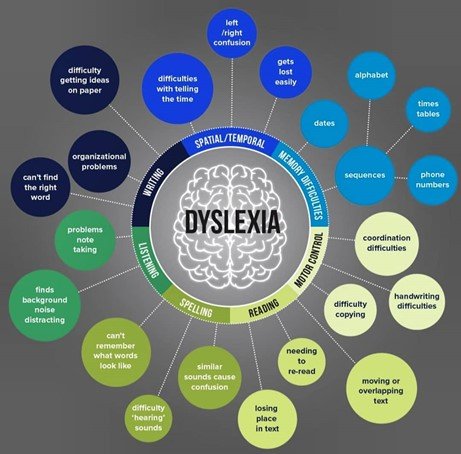
For example, people who are dyslexic may also struggle with reading comprehension, writing, spelling, and even math. Young dyslexics also tend to struggle with other things unrelated to reading, like attention span, sequencing (remembering things in order), motor control, and left and right confusion leading to wider issues affecting social interaction, memory, and dealing with stress. Dyslexics can end up struggling with everyday activities that most people take for granted because of the far-reaching issues stemming from dyslexia.

In order to understand how dyslexia affects our students and young readers, we need to take a look at phonological processing. Phonological processing is using all of the sounds of a language in order to process both spoken and written language. Phonological processing is a broad category that includes phonological awareness, working memory, and information retrieval. People who are diagnosed with dyslexia may struggle with one or all of these pieces of phonological processing.


Brain in the center of the image with descriptors of dyslexia surrounding the central image. Some of the descriptors of dyslexia include; difficulties with telling the time, losing place in a text, handwriting difficulties, times tables or the alphabet, sequencing, problems with note taking, organizational problems, and difficulty getting ideas on paper.


Recent Research

While science is constantly evolving and creating new insight into dyslexia and its effects, researchers have not yet determined what exactly causes dyslexia. What they do know, however, is that dyslexia is genetic; in other words, a child is more likely to develop dyslexia if one of their parents is dyslexic. Furthermore, if that child has any siblings, there is a 40% chance that the sibling could also have problems reading.

Researchers are getting closer to understanding exactly which parts of the brain are affected. When a person is reading, both hemispheres of the human brain are active, but the left hemisphere does most of the work. Pathways are created during the reading process, and each has a specific function. For instance, there is a pathway that facilitates ‘sight recognition’ (recognizing a word just by looking at it rather than breaking it down by individual sounds), which leads to another developed pathway that allows the reader to remember the meaning of that recognized word. This results in a series of connections leading to speech, articulation, and pronunciation. All of these processes happen simultaneously throughout the brain for a fluent reader.

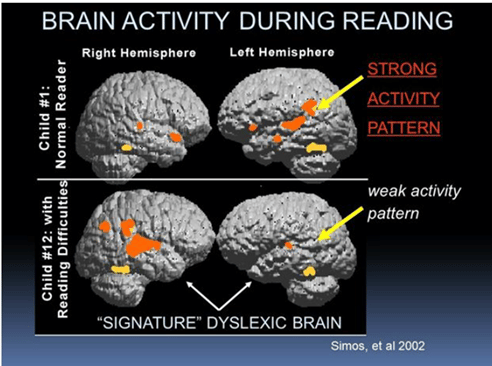
For someone with dyslexia, these internal pathways and connections form differently. There is little understanding as to why these differences occur, but researchers have found that the left hemisphere of the brain in a dyslexic person lacks the necessary connection to facilitate the pathways which allow a reader to become fluent. Instead, the right hemisphere begins to overcompensate and work harder to create those connections that are needed to read and comprehend. Below is a graphic that shows the activity in a brain of a non-dyslexic reader versus that of a dyslexic reader.


Side by side comparison of brain scans. Normal reader brain scans show strong activity pattern in the left hemisphere and then dyslexic brain scan shows a weak activity pattern in the left hemisphere.


Resources

If you struggle with dyslexia, know that you are not alone! Dyslexia is much more common than one might initially believe. Research has found that nearly 18% of the population is dyslexic. That is almost 1 out of every 5 people! Our resources at the Colorado Reading Center can help relieve some of the struggle and stress that may be caused by dyslexia. We provide resources to help readers, young and old, develop the essential skills for reading success.

People of all ages can suffer from dyslexia. However early interventions with young students, typically between Kindergarten and fifth grade, have been shown to be most effective. There are plenty of resources including books and videos to help understand the possibilities of overcoming Dyslexia, and there are numerous organizations such as the Colorado Reading Center that offer professional services for dyslexia remediation.