Posts

Websites That Strengthen Reading Skills

Building strong reading skills doesn’t have to feel like homework. With the right tools, students can practice phonics, decoding, spelling, and comprehension in playful, meaningful ways. Each resource below aligns with the Science of Reading and supports key literacy areas such as phonological awareness, orthographic mapping, vocabulary, and fluency

Starfall Education

Created by a doctor who overcame dyslexia, Starfall offers interactive games, songs, and books for grades K-5. Each activity is research-based and supports early literacy through systematic phonics practice and engaging repetition.

Education.com

After creating a free account, families can access an extensive library of reading games organized by grade level and skill area. It’s a great option for reinforcing comprehension and vocabulary between tutoring sessions.

IXL Language Arts

Covering pre-K through 12th grade, IXL combines quizzes, games, and progress tracking to help students master phonics, grammar, and comprehension at their own pace.

ABCya!

ABCya remains a classroom favorite for a reason — free, grade-based games that reinforce phonics, vocabulary, and fluency. Many games also integrate typing and grammar skills, making them a fun way to multitask learning.

Phonics and Stuff

Simple and teacher-friendly, this site includes printable phonics games, decodable books, and worksheets for emergent readers. It’s perfect for hands-on literacy centers or home practice.

Spelling City

Also known as LearningWorks for Kids, this site builds spelling, phonics, and working memory skills through no-login games. Students can practice sound-symbol correspondence and word analysis while having fun.

Reading Eggs

With thousands of digital books and interactive lessons, Reading Eggs motivates young learners to read more often. Parents can track growth over time through a structured, phonics-based progression. Includes a free 30-day trial.

All of these programs support key Science of Reading principles:

  • Phonemic awareness: recognizing and manipulating sounds in words.

  • Phonics and decoding: connecting letters and sounds systematically.

  • Fluency and comprehension: practicing reading smoothly and with meaning.

  • Vocabulary and spelling: reinforcing orthographic patterns through repetition and context.

Digital practice never replaces structured instruction — but it strengthens the foundation students build in one-on-one sessions. Used consistently, these tools can boost motivation, confidence, and reading independence.

Final Tip for Families

Pick two or three platforms to rotate each week. Pair 10–15 minutes of focused play with guided reading or structured literacy activities for the best results.

Happy Reading,

-CRC

Apps That Strengthen Reading Skills

Apps for Phonics and Word Building

Blending Board (Free on iTunes)

Create custom decks of phonemes and blends to strengthen decoding and blending. Excellent for students learning to connect sounds to letters.

Planet Lettera (Free on iTunes, ages 5+)

Students build and feed words to friendly monsters, practicing sound-letter connections in a game-based world. Perfect for early readers exploring phonemic awareness.

Pocket Phonics ($6.99, iTunes)

A systematic app that teaches letter sounds, handwriting, and decoding, closely aligned with the Science of Reading.

Sortegories (Subscription; available on iTunes, Android, and desktop)

Supports encoding, decoding, and vocabulary in context through word-sorting games that help build fluency and comprehension.

Spelling and Word Study Apps

Spelling Star ($1.99, Apple)

Upload or create custom spelling lists and track student progress. Students receive instant feedback and can review missed words for mastery.

A+ Spelling Test (Free)

Quickly build your own spelling tests with recorded word prompts. Simple and flexible for practicing high-frequency and decodable words.

SpellBoard ($4.99, Apple)

Add sentences, hints, or voice prompts to provide context for each spelling word. Ideal for grades 1–5 and students who benefit from auditory supports.

Mystery Word Town ($3.99, Apple)

Solve fun mysteries by spelling words correctly to unlock clues. You can add sight words or custom lists to personalize the challenge.

Night Zookeeper (7-Day Trial, Annual Membership)

Combines creative writing, spelling, and grammar in a colorful story world. Ideal for ages 6–12, it turns literacy practice into an adventure.

DoodleSpell (Free Trial, then Monthly Subscription)

Allows users to customize word lists, track progress, and reinforce spelling patterns. Designed for students ages 5–11.

Digital practice never replaces structured instruction — but it strengthens the foundation students build in one-on-one sessions. Used consistently, these tools can boost motivation, confidence, and reading independence.

Final Tip for Families

Pick two or three platforms to rotate each week. Pair 10–15 minutes of focused play with guided reading or structured literacy activities for the best results.

Happy Reading,

-CRC

What Parents Should Know About 504 Plans and IEPs

As a parent, you know your child best. If your child is struggling more than expected in school, you might be wondering what support is available. In Colorado, families have the right to ask their school district for a formal evaluation to see if their child qualifies for special education services through an Individualized Education Program (IEP) or accommodations under a 504 Plan.

The process often begins with a written request to your child’s school or the district’s Child Find office. From there, the school will gather information, conduct assessments (with your consent), and meet with you to discuss whether your child qualifies for extra supports.

Knowing where to start can feel overwhelming, but the good news is that Colorado offers clear procedures, resources, and parent supports to guide you every step of the way. Below are some key differences between each service and some help on how to get started.

Section 504 Plan

  • Based on Section 504 of the Rehabilitation Act of 1973, a civil rights law that prohibits discrimination on the basis of disability.
  • Ensures that a student with a disability has equal access to education and school programs by providing accommodations and supports.
  • Accommodations might include preferential seating, extended time on tests, breaks, use of assistive technology, modified assignments, etc.
  • You can learn more about Section 504 here: https://www.ed.gov/laws-and-policy/individuals-disabilities/section-504

Individualized Education Program (IEP)

  • Governed under the Individuals with Disabilities Education Act (IDEA).
  • An IEP is a legally binding document that spells out special education services, supports, and modifications your child needs to make progress in school.
  • It describes your child’s current performance, measurable goals, how those goals will be assessed, and when/where services will be delivered.
  • You can learn more about the IDEA here: https://www.ed.gov/laws-and-policy/individuals-disabilities/idea

Key Differences

Feature 504 Plan IEP
Legal basis Rehabilitation Act (civil rights) IDEA (special education law)
Who qualifies Broad definition of disability; substantial limitation in one or more life activity (e.g., learning) Must meet IDEA’s criteria (one of the categories) and need special education to benefit from school
Type of support Accommodations and supports in general education Specialized instruction, related services, accommodations/modifications
Academic goals or benchmarks Typically no (or less detailed) goals Yes — annual goals, progress measurement
Team and process Usually a 504 team (teacher, admin, parent) Formal IEP team (parents, teachers, specialists, administrator)
Frequency of review Varies (often annually) At least annually; full reevaluation every 3 years (or more frequently if needed)
Scope of protections Includes access to extracurriculars, nonacademic settings, discrimination protections Also includes protections but more focused on instruction and educational progress

What to Expect and What Parents Should Do


Getting Started / Eligibility

Development

  • For an IEP, the IEP team meets to write the plan, including goals, services, accommodations, and how progress will be reported.
  • For a 504 plan, the team decides what accommodations and supports are needed to give your child equal access.

Implementation and Monitoring

  • Parents should stay involved: ask for progress reports, observe how supports are working, and request changes if needed.
  • Both plans should be reviewed periodically. For IEPs, there is at least an annual review and triennial reevaluation.
  • If you disagree with decisions, you have the right to due process, mediation, or an impartial hearing (for both 504 and IEP).

Why They Matter

  • Promote access and equity. These plans help reduce barriers so children with disabilities can engage meaningfully in school and reach their potential.
  • Reduce unnecessary frustration. With appropriate supports, a child may be better able to demonstrate their true strengths and keep pace with peers.
  • Legal protection. These are not merely helpful — they are rights guaranteed by law.

Navigating the world of resources and services can be daunting. Feel free to reach out the the Colorado Reading Center if you have any questions about this process or would like to start with an academic assessment to get an accurate measure of you child’s reading skills.


What is Dyslexia?

What is Dyslexia?

Dyslexia is a learning disability that affects a person’s phonological processing, making reading and writing challenging for the individual. People with dyslexia experience difficulty in identifying speech sounds and/or learning how they relate to letters and words.  While not every person with dyslexia experiences the same symptoms and difficulties with reading, dyslexia is a deficit in phonological processing.

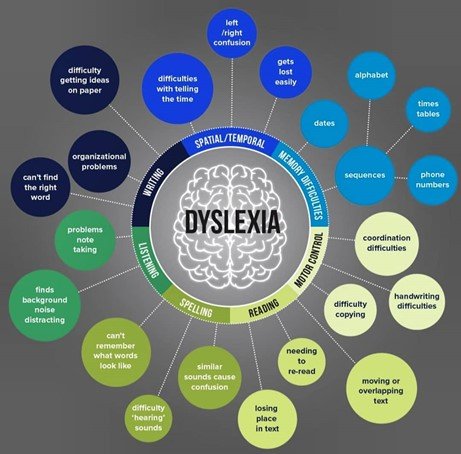
For example, people who are dyslexic may also struggle with reading comprehension, writing, spelling, and even math. Young dyslexics also tend to struggle with other things unrelated to reading, like attention span, sequencing (remembering things in order), motor control, and left and right confusion leading to wider issues affecting social interaction, memory, and dealing with stress. Dyslexics can end up struggling with everyday activities that most people take for granted because of the far-reaching issues stemming from dyslexia.

In order to understand how dyslexia affects our students and young readers, we need to take a look at phonological processing. Phonological processing is using all of the sounds of a language in order to process both spoken and written language. Phonological processing is a broad category that includes phonological awareness, working memory, and information retrieval. People who are diagnosed with dyslexia may struggle with one or all of these pieces of phonological processing.


Brain in the center of the image with descriptors of dyslexia surrounding the central image. Some of the descriptors of dyslexia include; difficulties with telling the time, losing place in a text, handwriting difficulties, times tables or the alphabet, sequencing, problems with note taking, organizational problems, and difficulty getting ideas on paper.


Recent Research

While science is constantly evolving and creating new insight into dyslexia and its effects, researchers have not yet determined what exactly causes dyslexia. What they do know, however, is that dyslexia is genetic; in other words, a child is more likely to develop dyslexia if one of their parents is dyslexic. Furthermore, if that child has any siblings, there is a 40% chance that the sibling could also have problems reading.

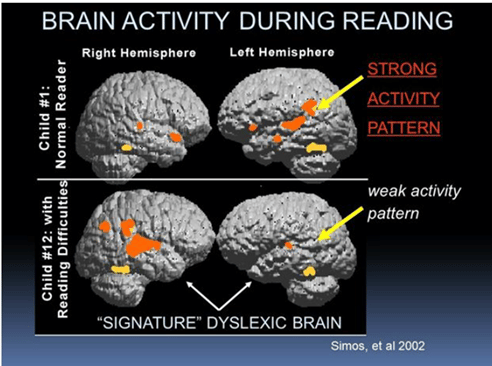
Researchers are getting closer to understanding exactly which parts of the brain are affected. When a person is reading, both hemispheres of the human brain are active, but the left hemisphere does most of the work. Pathways are created during the reading process, and each has a specific function. For instance, there is a pathway that facilitates ‘sight recognition’ (recognizing a word just by looking at it rather than breaking it down by individual sounds), which leads to another developed pathway that allows the reader to remember the meaning of that recognized word. This results in a series of connections leading to speech, articulation, and pronunciation. All of these processes happen simultaneously throughout the brain for a fluent reader.

For someone with dyslexia, these internal pathways and connections form differently. There is little understanding as to why these differences occur, but researchers have found that the left hemisphere of the brain in a dyslexic person lacks the necessary connection to facilitate the pathways which allow a reader to become fluent. Instead, the right hemisphere begins to overcompensate and work harder to create those connections that are needed to read and comprehend. Below is a graphic that shows the activity in a brain of a non-dyslexic reader versus that of a dyslexic reader.


Side by side comparison of brain scans. Normal reader brain scans show strong activity pattern in the left hemisphere and then dyslexic brain scan shows a weak activity pattern in the left hemisphere.


Resources

If you struggle with dyslexia, know that you are not alone! Dyslexia is much more common than one might initially believe. Research has found that nearly 18% of the population is dyslexic. That is almost 1 out of every 5 people! Our resources at the Colorado Reading Center can help relieve some of the struggle and stress that may be caused by dyslexia. We provide resources to help readers, young and old, develop the essential skills for reading success.

People of all ages can suffer from dyslexia. However early interventions with young students, typically between Kindergarten and fifth grade, have been shown to be most effective. There are plenty of resources including books and videos to help understand the possibilities of overcoming Dyslexia, and there are numerous organizations such as the Colorado Reading Center that offer professional services for dyslexia remediation.