When it comes to reading comprehension, vocabulary knowledge is essential. Without a strong vocabulary, readers may struggle to make sense of the texts they encounter. But why is vocabulary so important, and how can parents and educators help build it effectively?
Vocabulary: The Key to Unlocking Meaning
Vocabulary is the foundation of understanding. When readers know the meanings of the words they encounter, they can better understand sentences, paragraphs, and entire texts. Without this knowledge, comprehension becomes much harder, and the joy of reading can fade.
Research shows that a rich vocabulary enhances both basic understanding and deeper comprehension. Readers use vocabulary to grasp the literal meaning of a text and to infer hidden messages. Both types of understanding depend on a reader’s knowledge of words.
Vocabulary, Mental Imagery, and Cognitive Development
Vocabulary development plays a key role in cognitive growth. Each new word represents a concept or idea, and the more words a child learns, the better they understand the world. This expanded understanding helps them connect texts to their own experiences, deepening comprehension.
Mental imagery strengthens the connection between vocabulary and comprehension. Descriptive words help readers create pictures in their minds, making the text more engaging and easier to remember. For instance, phrases like “lush forest” or “towering skyscraper” trigger vivid mental images, enhancing understanding and creating a richer reading experience.
Building Vocabulary: Strategies for Success
Here are some practical strategies to support vocabulary development:
Read Aloud Together: Reading aloud introduces children to new words in context. Choose books slightly above their independent reading level to help expand their vocabulary.
Encourage Wide Reading: Provide access to a variety of materials, including fiction, nonfiction, poetry, and informational texts. Different genres introduce unique words and ideas.
Teach Word-Learning Strategies: Show students how to figure out unfamiliar words by teaching prefixes, suffixes, root words, and context clues.
Play Word Games: Games like Scrabble, Boggle, or vocabulary apps make learning fun and interactive.
Talk About Words: Discuss interesting or unusual words during conversations at home or in the classroom. This builds curiosity about language.
Use Visual Imagery: Use visual imagery to create vivid mental images of vocabulary words. This taps into personal experience as well as visualization for better memory.
Reinforce Through Writing: Encourage students to use new vocabulary in their writing. This strengthens understanding and helps solidify word meanings in memory.
Long-Term Benefits of a Strong Vocabulary
A strong vocabulary doesn’t just support reading comprehension—it’s a lifelong skill. From academic success to career readiness, vocabulary enables individuals to express themselves clearly, understand complex ideas, and engage with the world. It also enhances critical thinking and problem-solving abilities, which makes it a vital part of overall learning.
Final Thoughts
Building a strong vocabulary is an investment in a child’s success. By creating word-rich environments at home and in the classroom, parents and educators can empower young readers to thrive. Incorporating mental imagery techniques can make reading more vivid and memorable and turn every book into an adventure. The more words a child knows, the more opportunities they have—in books and in life.
If you or your child needs help with Reading Comprehension, we can help! Reach out to learn about our ReadingFish program for reading comprehension today!
https://coloradoreading.com/wp-content/uploads/Vocabulary-Head.png4301500Robert Whttps://coloradoreading.com/wp-content/uploads/colorado-reading-center-logo-1.pngRobert W2025-01-21 11:25:302025-09-25 10:57:19The Importance of Vocabulary for Reading Comprehension
The English language is built on 44 distinct sounds, or phonemes, that form the foundation of how we read and speak. While this may seem like a manageable number, the combinations of these sounds create endless possibilities for words. For emerging readers, the journey begins with identifying, articulating, and blending these sounds to form words.
If your child is struggling with reading, gaps in these foundational skills are often the reason.
The good news—these skills can be strengthened with the right instruction.
From a young age, children naturally begin to recognize and produce the sounds that make up spoken language. They then connect these sounds to labels, such as recognizing that the letter ‘a’ says the sound /a/, like in “apple.” This process, known as phonemic awareness, sets the stage for reading.
Step 2: Linking Sounds to Symbols
The next challenge is associating each sound with a visual representation—a letter or group of letters. This process involves three essential components:
Phoneme: The distinct sound.
Grapheme: The written symbol (e.g., the letter ‘a’).
Letter Name: The spoken label for the grapheme.
This connection between sound, symbol, and label forms the foundation of reading and writing.
The Complexity of English Sounds
Vowels and Consonants
Vowels: The five vowels (a, e, i, o, u) produce open, voiced sounds. For example, the sound /a/ in “cat” or /e/ in “meet.”
Consonants: The remaining letters (e.g., b, d, f) produce sounds by shaping or stopping airflow.
Digraphs and Letter Combinations
To represent extra sounds, letters are combined into digraphs where two letters identify and represent a new, distinct sound. Examples include:
Consonant Digraphs: th, sh, ch, wh, ng
Vowel Digraphs: oo (boot), ee (meet)
Short and Long Vowels
Short: /a/ as in “cat.”
Long: /ae/ as in “cake.”
While the short sounds are represented by just the letter, the long sounds often involve multiple spellings. Words like “weigh” and “way” use different letters to spell the same sound /ae/, which adds complexity for learners.
R-Controlled Vowels
/ar/ as in “car”
/er/ as in “her,” “girl,” or “turn”
/or/ as in “porch”
Additional Sounds
/oo/ as in “moon”
/uu/ as in “foot”
/oi/ as in “boil” or “boy”
/au/ as in “haul” or “awe”
/ou/ as in “out” or “wow”
The Challenges of Sound-Symbol Association
For emerging readers, associating sounds with their corresponding symbols can be a hurdle. The same sound may have multiple spellings, and the same letter combination can produce different sounds. For example, /th/ sounds different in “thin” versus “that.”
Additionally, individual learners face unique challenges. Some may struggle with auditory processing, making it difficult to distinguish sounds. Others may have trouble recalling letter names, shapes, or corresponding phonemes. These challenges highlight the importance of patience, creativity, and positive reinforcement in teaching.
Many struggling readers aren’t behind because of effort—they’re missing key reading skills.
At Colorado Reading Center, we rebuild these skills using structured, evidence-based instruction.
https://coloradoreading.com/wp-content/uploads/The-Colorado-Reading-Center.png4301500ColoradoReadinghttps://coloradoreading.com/wp-content/uploads/colorado-reading-center-logo-1.pngColoradoReading2024-12-23 12:48:132026-04-07 11:59:06The Building Blocks of Reading: Mastering the 44 English Phonemes
Identifying Dyslexia from Preschool to High School: Key Signs and Early Intervention
Dyslexia is one of the most common learning differences, affecting as many as 1 in 5 children in the United States. Since early intervention is crucial for helping individuals overcome reading and writing challenges, recognizing the signs of dyslexia at different stages of childhood can make a lasting difference. While dyslexia doesn’t go away, understanding its early markers helps children receive appropriate interventions to succeed academically and personally.
Signs at Every Stage
Many children with dyslexia go undiagnosed, especially if they are bright and develop coping strategies early on. This makes it essential for parents, educators, and healthcare providers to understand the signs of dyslexia and seek intervention early.
Dyslexia can affect children at all stages of their education, from preschool through high school, with different challenges emerging at each level. While every child is different, there are common signs to look out for. Recognizing these signs early allows for timely intervention, which can make a world of difference in a child’s academic and personal life.
Preschool (Ages 3–5): Early Language and Pre-Reading Skills
Dyslexia can begin to show as early as preschool. Although children at this stage are not yet reading, there are language and early literacy indicators that may suggest a child is at risk for dyslexia.
Signs to Look For:
Delayed speech development compared to peers
Difficulty learning new words or naming familiar objects
Trouble recognizing rhyming patterns (e.g., cat, hat, bat)
Challenges in remembering or learning the alphabet or letter names
Difficulty in understanding or following simple directions
Preschoolers with dyslexia might struggle with phonemic awareness, which is the ability to recognize and manipulate sounds in words. This can result in difficulties with rhyming or segmenting words into syllables—skills that are fundamental for reading later on.
Elementary School (Ages 6–11): Learning to Read and Write
Elementary school is typically when dyslexia becomes more apparent because children are expected to begin reading, writing, and spelling with increasing proficiency. At this stage, children with dyslexia may begin to fall behind their peers in these areas.
Poor spelling, often with phonetic errors (e.g., writing “fot” instead of “foot”)
Difficulty learning high-frequency sight words (e.g., “the,” “and,” “said”)
Avoiding reading aloud or reading for pleasure
Trouble organizing thoughts for writing, especially at the sentence or paragraph level
Problems with handwriting or letter formation (dysgraphia may also co-occur)
Children in this age group may also struggle with reading fluency, reading comprehension, and retaining information they’ve read. Dyslexia at this stage can cause significant frustration, leading children to avoid reading and writing tasks.
Middle School (Ages 11–14): Increased Academic Demands
As children move into middle school, the academic demands increase, and the emphasis shifts from learning to read to reading to learn. Students with dyslexia at this stage might struggle to keep up, especially in subjects that require extensive reading or written responses.
Signs to Look For:
Reading significantly below grade level
Difficulty understanding and summarizing text
Avoidance of reading assignments, particularly longer or more complex texts
Challenges with spelling and written composition
Trouble organizing essays or written responses
Slow reading speed, even for familiar texts
Difficulty with oral language tasks, like reading aloud in class
Middle school students with dyslexia may find it harder to manage the volume of reading across subjects like history, science, and English. They may also have trouble keeping up with written assignments, even if they understand the material orally.
High School (Ages 14–18): Advanced Reading and Writing Challenges
By high school, the demands for independent learning, advanced reading comprehension, and essay writing increase. Students with dyslexia often face significant challenges, especially if they haven’t received adequate intervention earlier in their schooling.
Signs to Look For:
Continuing difficulties with reading fluency and accuracy
Struggles with advanced reading comprehension and analyzing complex texts
Persistent spelling problems, particularly with less common or more complex words
Difficulty planning and organizing long written assignments, such as research papers
Avoidance of reading and writing tasks, leading to academic underachievement
Slow reading speed that impairs the ability to complete assignments on time
Low self-esteem or frustration due to academic struggles, despite putting in extra effort
At this stage, many high school students with dyslexia may have developed coping mechanisms, but these often break down as the workload increases. Without appropriate accommodations, such as extra time on tests, assistive technology, or structured literacy intervention, students may continue to struggle academically.
The Importance of Early Identification and Intervention
Early identification and intervention for dyslexia are critical for improving a child’s reading and writing skills, as well as their overall academic success. Research shows that the earlier dyslexia is identified, the more effective interventions can be in helping children close the achievement gap with their peers.
Individualized instruction: One-on-one tutoring tailored to the specific needs of the child can significantly improve reading skills.
Assistive technology: Tools such as text-to-speech software, audiobooks, and word processors with spell check can support students with dyslexia, particularly in middle and high school.
Schools, parents, and specialists can work together to ensure that students receive the support they need, whether through formal IEPs (Individualized Education Plans) or 504 Plans that provide necessary accommodations and interventions.
Conclusion
Dyslexia is a lifelong condition, but with proper support, children and adolescents with dyslexia can thrive academically and personally. Recognizing the signs early—whether in preschool, elementary, middle, or high school—empowers parents and educators to provide timely, targeted interventions that make a real difference in a child’s life.
International Dyslexia Association. “Dyslexia Basics.” IDA Website.
Understood.org. “Signs of Dyslexia at Different Ages.” Understood Website.
The Yale Center for Dyslexia & Creativity. “Dyslexia: What It Is, and Isn’t.” Yale Dyslexia.
National Institute of Child Health and Human Development (NICHD). “What is Dyslexia?” NICHD Website.
https://coloradoreading.com/wp-content/uploads/ID-Dyslexia-Header-Compressed.png11812100ColoradoReadinghttps://coloradoreading.com/wp-content/uploads/colorado-reading-center-logo-1.pngColoradoReading2024-10-15 11:48:192025-09-25 10:42:30Early Detection and Signs of Dyslexia
Dyslexia is a learning disability that affects a person’s phonological processing, making reading and writing challenging for the individual. People with dyslexia experience difficulty in identifying speech sounds and/or learning how they relate to letters and words. While not every person with dyslexia experiences the same symptoms and difficulties with reading, dyslexia is a deficit in phonological processing.
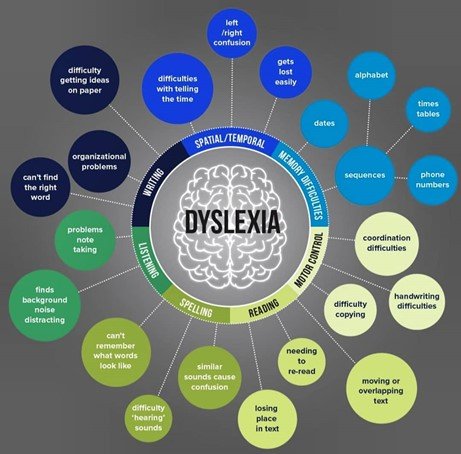
For example, people who are dyslexic may also struggle with reading comprehension, writing, spelling, and even math. Young dyslexics also tend to struggle with other things unrelated to reading, like attention span, sequencing (remembering things in order), motor control, and left and right confusion leading to wider issues affecting social interaction, memory, and dealing with stress. Dyslexics can end up struggling with everyday activities that most people take for granted because of the far-reaching issues stemming from dyslexia.
In order to understand how dyslexia affects our students and young readers, we need to take a look at phonological processing. Phonological processing is using all of the sounds of a language in order to process both spoken and written language. Phonological processing is a broad category that includes phonological awareness, working memory, and information retrieval. People who are diagnosed with dyslexia may struggle with one or all of these pieces of phonological processing.
Recent Research
While science is constantly evolving and creating new insight into dyslexia and its effects, researchers have not yet determined what exactly causes dyslexia. What they do know, however, is that dyslexia is genetic; in other words, a child is more likely to develop dyslexia if one of their parents is dyslexic. Furthermore, if that child has any siblings, there is a 40% chance that the sibling could also have problems reading.
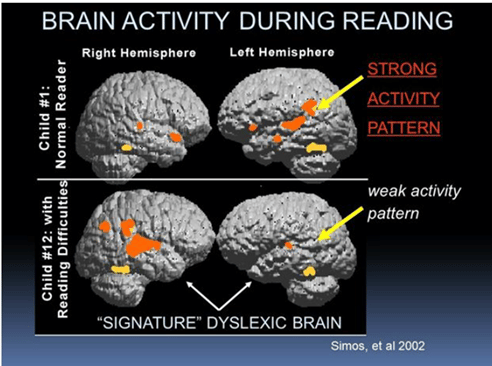
Researchers are getting closer to understanding exactly which parts of the brain are affected. When a person is reading, both hemispheres of the human brain are active, but the left hemisphere does most of the work. Pathways are created during the reading process, and each has a specific function. For instance, there is a pathway that facilitates ‘sight recognition’ (recognizing a word just by looking at it rather than breaking it down by individual sounds), which leads to another developed pathway that allows the reader to remember the meaning of that recognized word. This results in a series of connections leading to speech, articulation, and pronunciation. All of these processes happen simultaneously throughout the brain for a fluent reader.
For someone with dyslexia, these internal pathways and connections form differently. There is little understanding as to why these differences occur, but researchers have found that the left hemisphere of the brain in a dyslexic person lacks the necessary connection to facilitate the pathways which allow a reader to become fluent. Instead, the right hemisphere begins to overcompensate and work harder to create those connections that are needed to read and comprehend. Below is a graphic that shows the activity in a brain of a non-dyslexic reader versus that of a dyslexic reader.
Resources
If you struggle with dyslexia, know that you are not alone! Dyslexia is much more common than one might initially believe. Research has found that nearly 18% of the population is dyslexic. That is almost 1 out of every 5 people! Our resources at the Colorado Reading Center can help relieve some of the struggle and stress that may be caused by dyslexia. We provide resources to help readers, young and old, develop the essential skills for reading success.
People of all ages can suffer from dyslexia. However early interventions with young students, typically between Kindergarten and fifth grade, have been shown to be most effective. There are plenty of resources including books and videos to help understand the possibilities of overcoming Dyslexia, and there are numerous organizations such as the Colorado Reading Center that offer professional services for dyslexia remediation.
https://coloradoreading.com/wp-content/uploads/silhouette-brain-logic-mental-health-know-communication-1444651-pxhere.com_.jpg24002400ColoradoReadinghttps://coloradoreading.com/wp-content/uploads/colorado-reading-center-logo-1.pngColoradoReading2022-05-17 20:24:002025-09-25 10:52:31What is Dyslexia?
If you think back into history when you were just beginning to read and spell, there was most likely a moment when you asked yourself: “Why do we spell words the way we do?” You probably asked yourself this during a moment of frustration while trying to master a challenging word.
A student may read the word “love” as /loav/, or they may spell the word “of” u-v. In one sense these are great errors to be making, especially on their first attempt. They are demonstrating their knowledge of language up to this point and trying to work rationally from what they know. These types of errors show that they have internalized some orthographic rules (that is, the conventions of the English language) and are trying to apply them.
Another question is why are these answers wrong? Why isn’t love spelled “luv,” or enough “enuf?” English is a living language, which means it is in constant flux. For example, the word love was taken from the Latin word lubere, digested by Old German into luba, rung through Old English as lufa to emerge in our current variation: love. New words are being added all the time. In addition to that, English is a real melting pot of a language that pulls from lots of languages (many of which don’t get along with each other). A language like Latin is defined and doesn’t need to absorb or evolve over time. English in 500 years will no doubt be just as uncanny as the language of Shakespeare is to us today.
There have been attempts to create a more rational language that has fixed logical orthographic rules. Esperanto is one example of this. English has a lot of spelling challenges that relate to homophones and which mainly serve our understanding of language more than our spelling abilities.
For English speakers we are stuck having to learn a good deal of orthographically inconsistent words, or as we say: “words that just don’t play fair.” We have to learn to embrace, and possibly love, the hodgepodge that is our language.
How then should a student be corrected when they spell a word incorrectly like u-v? What should we do when they read “of” as “off?” There is an underlying skill that allows students to recognize unfair words. It is called visual memory.
Visual memory is the ability to hold an image in our mind’s eye. This could be an image of an object, a person’s face, or in the case of reading: symbols like letters. It is the ability to recognize, discriminate and reproduce mental images of symbols, and more specifically, letters and words.
Knowing now that this skill is at work when we read, we can do more than just practice the word that was an error. We can directly stimulate and develop this skill. One way to help reinforce an unfair word that a student struggles to remember is to have them create an image of the word in their mind. You can have them draw the letters from their memory on the table with their finger, or in the air in front of them. This type of visual memory practice will help to create and reinforce the neural imprint the student is making of the word. Once the student has a strong matching imprint of how the word should look in their mind, they will experience more success recognizing it, reading it, and spelling it. Little by little, they will build their word knowledge to encompass all the words needed for the English language. If you still think we should have more rational spelling rule in our language, then I encourage you to read the following.
Below is a well-known humorous example for the need for complex spelling rules: The European Union commissioners have announced that agreement has been reached to adopt English as the preferred language for European communications, rather than German, which was the other possibility. As part of the negotiations, Her Majesty’s Government conceded that English spelling had some room for improvement and has accepted a five-year phased plan for what will be known as EuroEnglish (Euro for short). In the first year, ‘s’ will be used instead of the soft ‘c’. Sertainly, sivil servants will resieve this news with joy. Also, the hard ‘c’ will be replaced with ‘k.’ Not only will this klear up konfusion, but typewriters kan have one less letter. There will be growing publik enthusiasm in the sekond year, when the troublesome ‘ph’ will be replaced by ‘f’. This will make words like ‘fotograf’ 20 per sent shorter. In the third year, publik akseptanse of the new spelling kan be expekted to reach the stage where more komplikated changes are possible. Governments will enkourage the removal of double letters, which have always ben a deterent to akurate speling. Also, al wil agre that the horible mes of silent ‘e’s in the languag is disgrasful, and they would go. By the fourth year, peopl wil be reseptiv to steps such as replasing ‘th’ by ‘z’ and ‘W’ by ‘V’. During ze fifz year, ze unesesary ‘o’ kan be dropd from vords kontaining ‘ou’, and similar changes vud of kors; be aplid to ozer kombinations of leters. After zis fifz yer, ve vil hav a reli sensibl riten styl. Zer vil b no mor trubls or difikultis and evrivun vil find it ezi tu understand ech ozer. Ze drem vil finali kum tru.
https://coloradoreading.com/wp-content/uploads/head-1.jpg9531024ColoradoReadinghttps://coloradoreading.com/wp-content/uploads/colorado-reading-center-logo-1.pngColoradoReading2017-09-28 19:46:422022-10-05 14:39:23Language Isn't Logical, But We Want It To Be
You may know the riddle: When is a door not a door? Answer: When it’s ajar.
It’s a simple joke, but it shows how much riddles and puns depend on wordplay. To understand them, readers need a strong grasp of English — especially the tricky world of homophones and homographs.
What Are Homophones?
A homophone is a word that sounds the same as another word but has a different meaning.
Heterographs: Different spelling + different meaning, but identical sound.
Here vs. hear
To, too, two
Other homophones can share spelling but shift meaning depending on context.
He “gasses” up the truck vs. The atmosphere has many “gases”
Subgroups of Homophones
Homonyms → Same pronunciation, different meanings.
I “tire” of this vs. The “tire” is flat
Their / there / they’re
Heterographs → Subset of homonyms; different spelling + different meaning + same sound.
Lie down vs. Tell a lie
Heteronyms → Same spelling + different pronunciation + different meaning.
Row a boat vs. Family had a row
What Are Homographs?
A homograph is a word with the same spelling but different meanings.
Example: Tire (to grow weary) vs. Tire (on a car).
Some homographs are also heteronyms when the pronunciation changes.
Why This Is Challenging for Readers
English is a mix of influences and spellings, which makes it full of confusing pairs and groups of words. For students, especially those with learning differences, this can feel overwhelming.
Teachers can help by:
Giving plenty of exposure to words in context.
Reinforcing spelling and meaning through repetition.
Using visual imaging strategies so students build a mental “snapshot” of each word.
The Bottom Line
Homophones, homographs, and their cousins create wordplay, jokes, and sometimes confusion. But with practice and support, students can build the lexical knowledge they need to master these tricky words — and even enjoy the humor in a good riddle.
https://coloradoreading.com/wp-content/uploads/door_vector_287808-1.jpg425425ColoradoReadinghttps://coloradoreading.com/wp-content/uploads/colorado-reading-center-logo-1.pngColoradoReading2016-09-21 20:27:562025-09-25 11:18:21Homophones, Homographs, and Why They Matter for Readers