

Why Your Child Can Be Smart and Still Struggle to Read
When parents first discover that their child is having difficulty learning to read, one of the most common reactions is confusion.
“But she’s so smart.”
“He can build incredible LEGO creations.”
“She remembers everything about dinosaurs.”
“He can solve math problems in his head.”
If this sounds familiar, you’re not alone.
One of the biggest misconceptions about reading is that intelligence and reading ability always develop together. In reality, they are different skills. A child can be highly intelligent, curious, creative, and articulate while still finding reading frustratingly difficult.
Understanding why can be the first step toward helping your child become a confident reader.

Reading Is Not a Natural Skill
Unlike speaking, reading is not something our brains are born knowing how to do.
Children learn to talk naturally by hearing language every day. Reading is different. The brain must learn to connect printed letters with the sounds of spoken language and blend those sounds into words. That process requires explicit instruction and practice.
For some children, these connections form quickly. For others, they require much more structured teaching.
Intelligence and Reading Are Different Abilities
Think about learning to play the piano.
A person may be brilliant at mathematics but still need years of practice before they can perform a concerto. Reading works much the same way.
A child’s intelligence influences how they think, solve problems, and understand ideas.
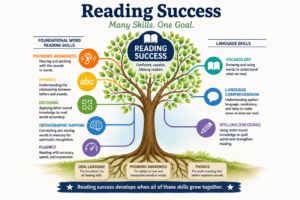
Reading depends on additional skills, including:
- Phonemic awareness (hearing and manipulating speech sounds)
- Phonics (connecting letters to sounds)
- Decoding unfamiliar words
- Reading fluency
- Vocabulary
- Language comprehension
A weakness in one or more of these areas can make reading difficult, even when a child excels everywhere else.

Signs Your Child May Need Additional Reading Support
Many struggling readers are excellent at hiding their difficulties.
They may:
- Memorize books instead of reading the words.
- Guess words from the first letter or pictures.
- Avoid reading aloud.
- Become frustrated or tired while reading.
- Say they hate reading.
- Understand stories when someone else reads them but struggle independently.
These behaviors are often mistaken for laziness or lack of effort. More often, they are signs that reading has become hard work.
Practice Alone Isn’t Always the Answer
Parents often hear, “Just have your child read more.”
Practice is important, but only when children have the skills they need to succeed.
Imagine asking someone to practice shooting basketball free throws without first showing them how to hold the ball or aim at the basket. They might improve a little through repetition, but progress would be slow and frustrating.
Reading works the same way.
When children receive instruction matched to their specific needs, practice becomes far more effective because they are building on a solid foundation.
The encouraging news is that children who struggle to read can make remarkable progress with the right instruction. Research consistently shows that early, evidence-based intervention helps children develop the skills needed to become successful readers. The earlier difficulties are identified, the easier they are to address before frustration and low confidence begin to grow.
Could Your Child Benefit from a Different Approach to Reading?
Many bright children struggle with reading, not because they lack ability, but because they simply learn differently.
At Colorado Reading Center, we provide personalized, one-on-one reading instruction that helps students build confidence, strengthen foundational skills, and become successful readers.
Wondering if your child could benefit from individualized reading support?
Frequently Asked Questions
Can a smart child have dyslexia?
Yes. Dyslexia has nothing to do with intelligence. Children with dyslexia often have average or above-average intelligence but struggle to connect letters with the sounds they represent. Many talented scientists, entrepreneurs, artists, and professionals have dyslexia. With evidence-based instruction, children with dyslexia can become successful readers.
Why is my child good at math but struggles to read?
Reading and mathematics rely on different parts of the brain and different sets of skills. A child may excel at logical reasoning, problem solving, or memorization while finding phonics, decoding, or reading fluency difficult. Strength in one area does not guarantee strength in another.
Will my child eventually catch up without extra help?
Some children develop reading skills later than others, but persistent reading difficulties rarely disappear on their own. If your child continues to struggle despite quality classroom instruction, early intervention is the best way to prevent gaps from growing larger over time.
How do I know if my child is just a late reader or has a reading difficulty?
Occasional challenges are normal when children are learning to read. However, if your child consistently avoids reading, guesses at words, struggles to sound out unfamiliar words, or falls behind classmates over several months, it may be time for a professional reading evaluation.
Is reading every night enough to improve my child’s reading?
Reading together every day is one of the best things families can do, but practice alone cannot replace effective instruction. If a child is missing foundational skills like phonemic awareness or phonics, simply reading more may lead to frustration rather than improvement. The right instruction makes practice much more effective.
My child understands stories when I read them aloud. Why can’t they read them independently?
Listening comprehension and reading are different skills. Your child may understand complex ideas when someone else reads because they don’t have to spend mental energy decoding words. Learning to decode accurately and fluently allows children to access those same stories on their own.
Can reading struggles affect my child’s confidence?
Absolutely. Many struggling readers begin to believe they aren’t smart simply because reading feels harder for them than for their classmates. Early support not only improves reading skills but also helps rebuild confidence and encourages children to enjoy learning again.
What kind of reading instruction is most effective?
Research consistently supports structured, systematic instruction that teaches phonemic awareness, phonics, fluency, vocabulary, and comprehension in a logical sequence. This approach, often referred to as the Science of Reading, has been shown to help both typical readers and students with reading difficulties develop strong literacy skills.
How can Colorado Reading Center help?
At Colorado Reading Center, we provide one-on-one reading instruction tailored to each student’s needs. Our individualized lessons focus on building the foundational skills that confident readers need while helping students develop the confidence to succeed both in school and beyond.
About the Author
Robert Windle is the Director of Colorado Reading Center and has spent more than two decades helping children and adults become confident readers through individualized, evidence-based instruction. He specializes in structured literacy, dyslexia intervention, and reading assessment.


